

Vermont Afterschool is proud to be partnering with STEM Next to make out-of-school STEM opportunities a reality for Vermont’s young people, to help them thrive in STEM and beyond. Through afterschool and summer programs, we believe every child should have STEM opportunities that inspire curiosity, innovation, and the critical thinking skills for whatever comes next.
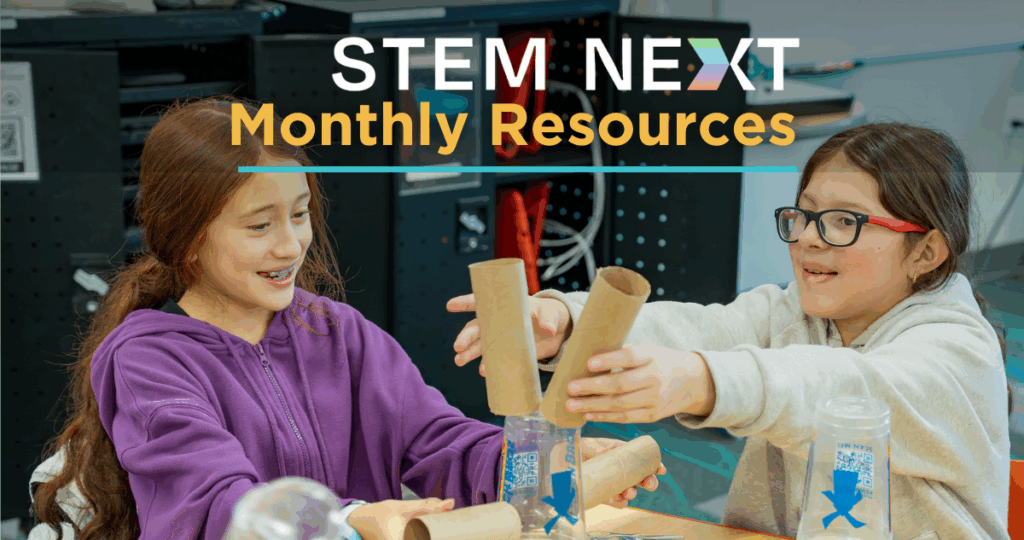

March brings new ways to spark curiosity, explore careers, and connect STEM learning to the real world through space exploration, health sciences, and computer science. These opportunities are designed for afterschool and summer programs looking for flexible, engaging, and career-connected STEM experiences.
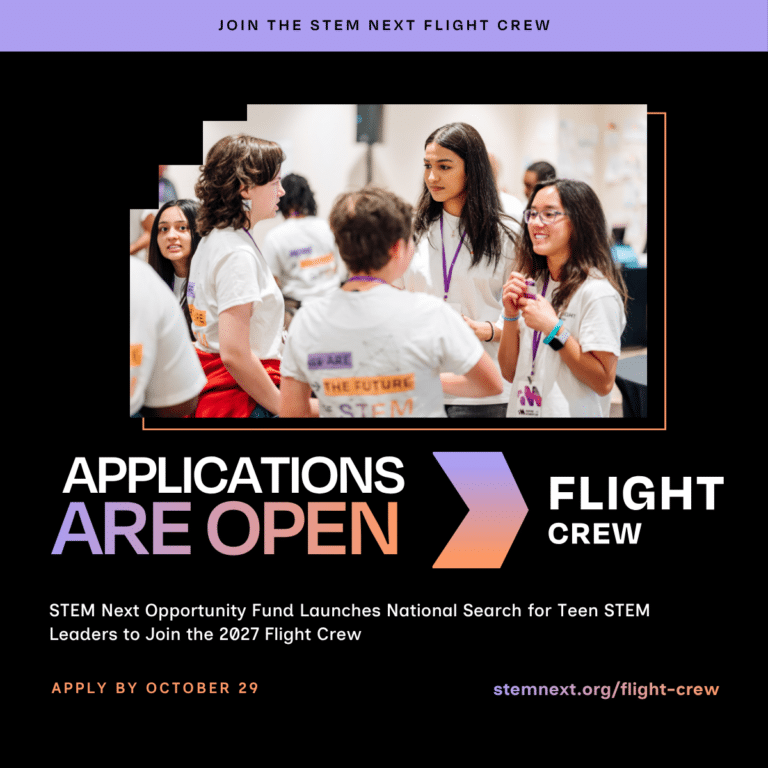
The application for the 2027 STEM Next Flight Crew is now OPEN! STEM Next has launched a nationwide search for the next Flight Crew — national youth ambassadors who represent their states as they develop leadership and communication skills, share their stories on regional, state and national stages, and lend their voices to push for more afterschool and summer STEM opportunities.
Please encourage youth ages 13-18, with experience in afterschool and summer STEM learning and an interest in developing public speaking and leadership skills, to apply today. The deadline to apply is 11:59PM EST on October 29, 2026.
From January through June 2027, Flight Crew members:
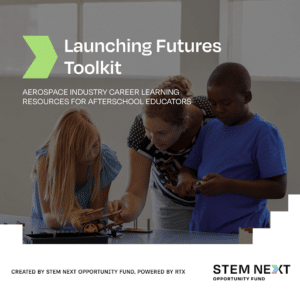
The Launching Futures Toolkit, created by STEM Next and powered by RTX, equips educators with practical resources to connect young people to the fast-growing world of space and aerospace careers. Built around the four strategies in STEM Next’s Career-Connected Learning Framework, the toolkit is designed to make it easy for afterschool and informal educators to bring aeronautical and aerospace careers to life. Inside, you’ll find:
Click here to access the toolkit.
STEM Next and RTX hosted a webinar launching this toolkit and the strategies to bring aerospace career learning to programs. Click here to watch a recording.
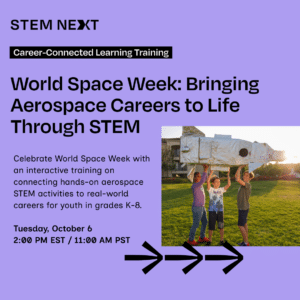
Celebrate World Space Week by helping young people discover where an interest in aerospace STEM could take them. In this interactive training, afterschool and summer educators will explore how hands-on aerospace activities can introduce youth to real-world careers and help them understand the STEM knowledge and skills professionals use every day.
Using examples from meteorology, the basics of flight and aerospace engineering, participants will learn how to start with an aerospace career and build an engaging activity around it—connecting what youth are doing and learning to the people, skills and possibilities behind the work.
Designed for educators serving youth in grades K–8, the training will use STEM Next’s Career Framework to help participants create meaningful career-connected learning experiences. Participants will leave with practical strategies, ready-to-use activity examples and aerospace career profiles they can use during World Space Week and throughout the year to help young people see the possibilities—and themselves—in future STEM careers. Participants will also have an opportunity to win STEM kits or a $100 gift card for their programs.
When: October 6 (2:00–3:00 PM EST)
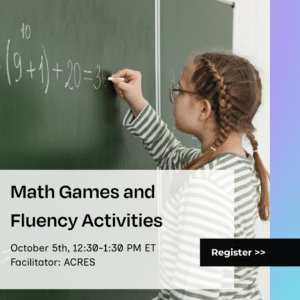
Come engage in fluency math games and activities that support youth in learning math facts and becoming fluent in computation while having fun in the process! This is a free, LIVE, virtual workshop that will last one hour. For more information, email acres@mmsa.org.
When: October 5 (9:30–10:30 AM EST)
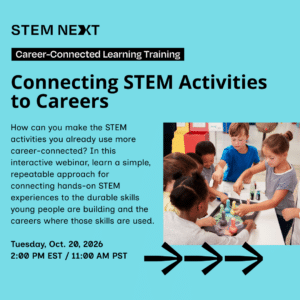
Kick off the school year with 10 engaging, hands-on STEM and engineering activities designed for youth in grades K–8 using common, low-cost materials that work well in out-of-school time settings. In this interactive webinar, participants will explore how familiar STEM activities can become powerful career-connected learning experiences when intentionally designed to build the durable skills and STEM competencies young people need for future success.
Each activity will highlight opportunities to develop skills such as problem-solving, collaboration, creativity, communication, and critical thinking—and connect those skills and STEM concepts to real-world STEM careers. Participants will experience fresh twists on familiar favorites and learn practical strategies for making STEM activities more intentional, accessible, and connected to the world of work.
Participants will leave with 10 ready-to-use activities and ideas for helping youth see the connection between what they are doing in afterschool today, the skills they are building, and the STEM careers they might pursue tomorrow. Participants will also have an opportunity to win STEM kits or a $100 gift card for their programs.
When: October 20 (2:00–3:00 PM EST)
Tilly Lockey is one of the youngest and most inspiring women in STEM fields, known for championing the fusion of AI, technology and human empowerment. A UK-based artist and bionic arm ambassador, she co-developed the AI-powered Hero Arm with Open Bionics from the age of nine, helping transform the future of prosthetics. After losing both hands to meningococcal septicaemia as a baby, Tilly turned adversity into innovation, creating lightweight, muscle-responsive bionic limbs that prioritise individuality and function. Ready to build your own prosthetic arm? Check out the resources below:
Hands On Activity: The Power in Prosthetics (Grade 3–5) — Youth create a functional prosthetic hand that will be useful for day-to-day tasks. The prototype will need to include moveable fingers that bend to pick up a small Styrofoam cup, a large foam die, and a whiteboard eraser. Youth will be paired into groups of two to begin planning, designing, and building their prototype. Each group will then test and evaluate their prototype by using it to pick up materials as listed above. Youth will improve their prototype as needed.
Hands On Activity: Make a Robot Hand Using Drinking Straws (Grades 3–8) — Imagine how cool it would be to build a robot hand that could grasp a ball or pick up a toy. In this robotics engineering project, you will learn how to use drinking straws, sewing thread, and a little glue to make a remarkably lifelike and useful robot hand. What will you design your robot hand to do? Pick up a can? Move around a ping pong ball? It is up to you! With these starting instructions, you can design any type of hand. You will simulate human finger anatomy as the basis for a fully functional robot hand that is easy to build and does not require complicated tools.
Middle schoolers don’t have to pick a career yet—but research shows they’re already curious and eager to explore what’s possible. This article provides 8 concrete ways educators can spark career exploration and knowledge in middle school youth. Click Here to Read the Article.
