Afterschool Professionals have a lot going on, and we want to help! One way we know how to help is by coming up with activities. And so, welcome to The Launchpad, a quarterly curation of curriculum perfect for afterschool programs. These activities will vary by content areas, lengths, difficulties, and ages. To find out when new Launchpads are available, sign up for our newsletter!
We hope these activities make life a little easier and provide some support to all of the wonderful and critical work you do. If you have any feedback or suggestions for what to include in the newsletter, please let us know!
STEM Activity: Mission Rainforest
Grades K–5
From: MIZZEN EDUCATION
Join Go2Science in the rainforests of Panama in Mission Rainforest! Use the video-based activities to follow along with Beth and Curtis to research a big question about blue Morpho butterflies. Start the adventure with Dr. Mitra, learning about blue Morpho butterflies and stating a hypothesis. Then, continue learning about animals and plants in habitats like the rainforest and ocean. There are 12 activities that you can go through, or just pick and choose what works for your program.
If you are interested in more resources from Go2Science, contact Katie.
Social Studies: Community – Where Does Sense of Responsibility Begin?
All Ages
From: Canadian Institute of Planners
To celebrate the 250th anniversary of our country, do this “We” are “They” community activity, or the several others in this resource.
Introduction
As a resident of your community, are you responsible for what happens to the land around you? What about your neighbourhood? How far does your sense of responsibility go? Does accepting responsibility also mean doing something – that you will act to take care of the place, fix a problem, plan to make it better? When you, or others say, “They ought to do something about that”, who is “they”?
When do you say “my” neighborhood? When do you say “their” neighborhood?
- At the corner?
- When you step outside?
- Across the street?
- A few blocks away?
What makes you feel like you’re part of your neighbourhood? What makes you feel like saying, “Who cares?”
Steps: The Candy Bar Wrapper Exercise
Help students identify their own sphere of responsibility.
- Ask this question: “How far will you lean out of bed to pick up a candy bar wrapper?”
- Will you get out of bed to pick it up in your…
- Bedroom?
- Will you pick it up in…
- the house?
- out on the street?
- at the corner?
- across the street?
- anywhere you see it?
- Where do you think the property line is that you won’t cross
- Will you get out of bed to pick it up in your…
- Where has someone made you feel that you don’t belong?
- Making it a better place…
- What things can you do to make your home a better place?
- Your school?
- Your neighbourhood?
- Your community?
STEM Activity: I Wonder
All Ages
From: National Inventors Hall of Fame
Click here to download the activity.
Introduction
Many inventors share that invention often begins with observing a problem. Observable events or processes that happen in the natural world are known as phenomena. Exploring phenomena will help you build your observation skills on your invention pathway!
Materials
- Paper, sketchbook, or journal
- Observation tools, if available (binoculars, magnifying glass)
- Pencil
Instructions
- Find a sketchbook, journal or just a blank piece of paper, and head outside to observe your surroundings.
- Look around and see what you notice. Perhaps you observe a shadow of a tree on the ground, or tracks in the dirt made by a small bug crawling by. Phenomena can be anything that piques interest or gets you to ask “Why?” or “How does that happen?” or say “I wonder…”!
- In your journal or on your paper, sketch, draw or jot down some notes about what you have observed.
- Now, think about three things your observations make you wonder (e.g., do you wonder how a shadow is made or how the angle of sunlight changes an object’s shadow?).
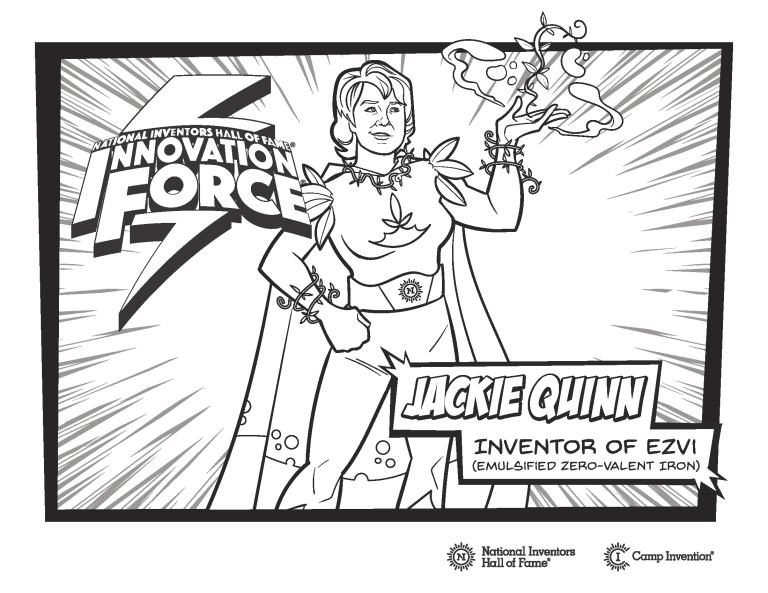
- Next, investigate some of your wonderings. Listen to National Inventors Hall of Fame Inductee and NASA scientist Jacqueline Quinn’s video message about the power of “I wonder” for inspiration.
- What did you discover through investigating your wonder questions? Add your discoveries to your notes.
Extension
Forced Connections is a creative thinking tool where you pair seemingly unrelated ideas to make new connections.
Take one of the phenomena you observed, or a fun fact you discovered through your research, and use it to form a question that can help you generate ideas. For example, say a phenomenon you observed was a tree’s shadow. If you used this to inspire your brainstorming related to the question “What might be a fun theme for a party?” it could lead you to ideas like: putting on a puppet show, making shadow art, inviting everyone in your family tree, etc.
What are we discovering?
Scientists often build ideas based on direct observations in order to explain and predict phenomena. Many inventors share the power of observation as they gather data to identify challenges and opportunities to pursue, and gaps to close. Click here to discover what NIHF Inductee Roger Angel observed through his first telescope. Many inventors engineer solutions to problems they identified through observations they made in the world, and then sought to better understand the hows and whys behind those observations, ultimately resulting in novel and useful solutions.
Environmental/Outdoor: Project Wild
All Ages
From: Vermont Fish & Wildlife Department
Project Wild (also Growing Up Wild for ages 3-7, and Aquatic Wild and Flying Wild for all ages) provides you with a training and guidebook to run the activities. Contact Ali Thomas at VT Fish and Wildlife to get started this summer!
We hope these activities will make life a little easier and provide some support to all of the wonderful work you do. Please let me know if you have any feedback or suggestions about this newsletter – want more activities, want more specific content, want less, etc. This is meant to support YOU and help you provide youth with engaging activities, so please let us know how we can help! Have a great summer!